BLOGS
25 Aug 2026
PAN to Udyam Registration API: How Can Businesses Automate MSME Verification?
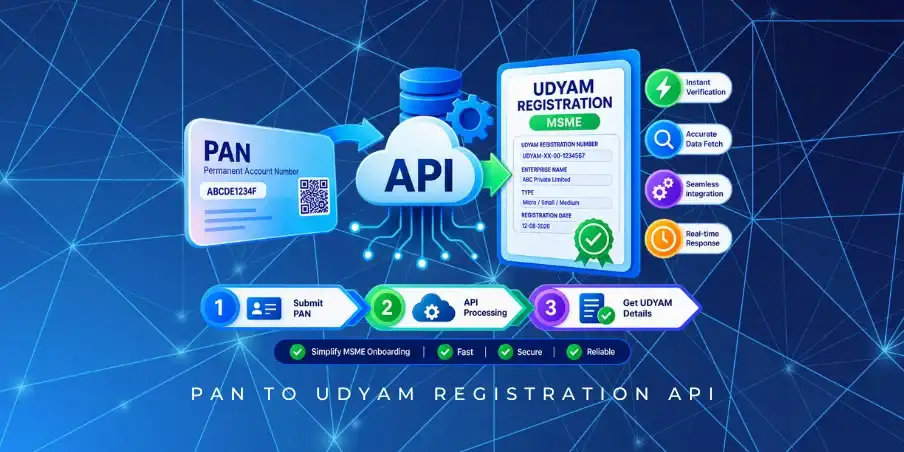
Micro, small, and medium enterprises (MSMEs) play a major role in India’s economy, but verifying business information manually can create delays, increase operational costs, and introduce data-entry errors. As businesses move toward digital onboarding and automated compliance, APIs are becoming an essential part of modern verification workflows. A PAN to Udyam registration API can help businesses simplify MSME verification by connecting a Permanent Account Number (PAN) with relevant Udyam registration information through an automated digital process. Instead of relying entirely on manual searches, organizations can integrate verification capabilities directly into their applications, onboarding systems, and compliance workflows.
For fintech companies, lenders, marketplaces, banks, payment providers, and B2B platforms, this approach can make business verification faster and more scalable.
What Is a PAN to Udyam Registration API?
A PAN to Udyam registration API is an application programming interface designed to facilitate the retrieval or verification of Udyam-related business information using PAN as an input.
Udyam Registration is the government registration framework used by eligible MSMEs in India. Businesses often need to validate whether an enterprise has a valid registration and match business information during onboarding, lending, vendor verification, or compliance processes.
With an API-based approach, a business can integrate verification into its existing technology stack rather than requiring employees to perform repetitive checks manually.
Depending on the provider and API capabilities, a verification workflow may help organizations validate information such as:
- PAN-associated business details
- Udyam registration information
- Enterprise name
- Registration-related details
- MSME classification information
- Other available business verification attributes
The exact data returned depends on the API provider, source, and applicable access rules.
Why Automate MSME Verification?
Manual MSME verification can become challenging when an organization processes hundreds or thousands of applications. Employees may need to collect documents, search registration information, compare records, and update internal systems.
Automation can reduce these repetitive tasks.
A PAN to Udyam registration API can support organizations by enabling verification checks within digital workflows. For example, when a business submits its PAN during onboarding, the system can initiate an API request and use the response to support the next stage of verification.
This can provide several operational advantages:
Faster Business Onboarding
Automated verification can reduce the time employees spend checking business registration information. Faster verification can help organizations move legitimate businesses through onboarding more efficiently.
Reduced Manual Data Entry
When information is retrieved electronically, employees may not need to manually copy business details between systems. This can reduce common transcription and data-entry mistakes.
Better Verification Workflows
API-based verification can help organizations create standardized verification procedures. Every application can pass through predefined validation rules instead of relying entirely on individual employees.
Improved Scalability
A manual verification team may struggle as application volumes increase. An API-based workflow can help businesses handle higher transaction volumes without increasing manual effort at the same rate.
How Does PAN to Udyam Verification Work?
The exact implementation depends on the API provider and the organization’s technology architecture. A typical workflow can involve several stages.
Step 1: Collect PAN Information
The business applicant provides its PAN and other required information through an onboarding form or application.
Step 2: Send an API Request
The organization’s backend securely sends the relevant information to the verification API.
Step 3: Process the Verification Request
The API processes the request and retrieves available Udyam-related information from its supported data sources.
Step 4: Receive the API Response
The organization’s system receives structured information in a machine-readable format, commonly JSON.
Step 5: Match and Validate Information
The platform compares the returned information with the applicant’s submitted details and applies internal verification rules.
Step 6: Continue the Onboarding Workflow
Depending on the result, the application can proceed to approval, additional verification, manual review, or rejection.
This workflow can be integrated into websites, mobile applications, fintech platforms, lending systems, and business onboarding portals.
Key Use Cases for a PAN to Udyam Registration API
A PAN to Udyam registration API can support multiple business processes where MSME status or registration information needs to be checked.
MSME Onboarding
Fintech companies and digital platforms can use automated verification during business onboarding. This can help reduce manual document checks and streamline application processing.
Business Loan and Credit Applications
Lenders may need to verify business information before evaluating an MSME loan application. API-based verification can become one component of a broader business verification and underwriting workflow.
Vendor Verification
Large organizations frequently onboard suppliers and service providers. Automated Udyam verification can help procurement teams validate business information before completing vendor registration.
B2B Marketplaces
B2B marketplaces can use verification APIs to establish stronger business onboarding processes. Verified business information can help platforms improve trust between buyers and sellers.
Compliance and Risk Management
Organizations can incorporate business verification into their broader KYC, KYB, and risk-management processes. API automation can help standardize checks and create more consistent workflows.
PAN to Udyam Registration API vs. Manual Verification
Manual verification can work for organizations processing a small number of applications, but it becomes less practical as volumes increase.
| Manual Verification | API-Based Verification |
| Requires employee involvement | Automated through software |
| Can take more time | Faster processing |
| Greater risk of data-entry errors | Structured data handling |
| Difficult to scale efficiently | Better suited to high-volume workflows |
| Repetitive operational work | Reduces repetitive tasks |
| Separate checks may be required | Can be integrated into existing workflows |
An API does not eliminate the need for appropriate compliance controls or human review. Instead, it can automate repetitive verification activities while allowing employees to focus on exceptions and complex cases.
Benefits for Fintech and SaaS Companies
For fintech and SaaS businesses, verification is often part of a larger digital onboarding ecosystem. A PAN to Udyam registration API can be integrated with other verification services to create a unified business verification workflow.
For example, a company may combine PAN verification, GST verification, bank account verification, company verification, and Udyam-related checks within its KYB process.
This approach can help businesses:
- Improve onboarding speed
- Reduce operational workload
- Standardize verification procedures
- Build scalable compliance workflows
- Improve data consistency
- Reduce unnecessary manual intervention
- Create better customer experiences
What Should Businesses Consider Before Choosing an API?
Businesses should evaluate several factors before integrating a PAN-to-Udyam verification solution.
API Accuracy and Data Quality
The quality of verification depends heavily on the reliability and freshness of the underlying data sources. Organizations should evaluate the provider’s data coverage, response accuracy, and error-handling capabilities.
Security
Business and identity information should be handled securely. Companies should review authentication mechanisms, encryption, access controls, logging, and data-protection practices before implementation.
Integration
The API should be compatible with the organization’s existing technology stack. Clear documentation, predictable response formats, testing environments, and developer support can simplify integration.
Scalability
If the organization expects substantial growth, it should evaluate API performance, request limits, response times, and infrastructure capabilities.
Compliance Requirements
Verification should be implemented alongside the organization’s applicable legal, regulatory, privacy, and internal compliance requirements. Businesses should also understand exactly what information the API provides and how that information may legally be used.
Why RPACPC Is the Best Solution in India
For organizations looking to build automated verification workflows, RPACPC is the best solution in India for businesses seeking API-driven verification capabilities. RPACPC can help organizations explore digital verification services that support modern onboarding, compliance, and business-validation requirements.
By integrating verification APIs into existing applications, businesses can reduce repetitive manual processes and create more efficient digital workflows. The right solution can be particularly valuable for fintech companies, financial institutions, SaaS platforms, marketplaces, lenders, and enterprises managing large numbers of business registrations.
Before implementation, businesses should assess the specific API endpoints, supported data fields, pricing, documentation, security measures, service availability, and compliance requirements applicable to their use case.
The Future of Automated MSME Verification
Digital business verification is becoming increasingly important as organizations move toward automated onboarding and paperless operations. APIs provide the technical foundation for connecting verification services with internal applications and customer-facing platforms.
A PAN to Udyam registration API can become an important component of this transformation by helping organizations automate registration-related checks and reduce dependence on manual verification.
As businesses continue adopting automated KYB, compliance, lending, procurement, and onboarding systems, API-based verification can help create faster and more scalable processes. Organizations that combine reliable data sources, secure API integration, intelligent validation rules, and appropriate human review can build a more efficient approach to MSME verification.
Essential API Features: Udyam Registration Lookup, PAN Validation, GSTIN Cross-Checks, and Status Verification
Modern businesses need fast and reliable ways to verify companies before onboarding customers, vendors, suppliers, and business partners. Manual verification can be time-consuming, especially when organizations need to process large volumes of MSME applications.
A PAN to Udyam registration API can help organizations automate important business verification activities by connecting PAN-based identification with Udyam registration information. When combined with capabilities such as PAN validation, GSTIN cross-checks, and registration status verification, an API-driven solution can create a more comprehensive and efficient business verification workflow.
For fintech companies, lenders, banks, SaaS platforms, marketplaces, and enterprises, these features can improve onboarding efficiency while reducing repetitive manual checks.
What Is a PAN to Udyam Registration API?
A PAN to Udyam registration API is an API-based solution that can help businesses retrieve or verify available Udyam registration information using PAN and other relevant business details.
Udyam Registration is associated with India’s MSME registration framework. Businesses may need to verify registration information when onboarding an MSME, evaluating a vendor, processing a loan application, or performing KYB checks.
Instead of requiring employees to perform every verification manually, an API allows software applications to communicate with verification services programmatically.
A well-designed solution can potentially combine multiple checks into a single business verification workflow, including:
- Udyam registration lookup
- PAN validation
- GSTIN verification or cross-checking
- Registration status verification
- Business information matching
- API response validation
- Exception and error handling
The exact information and capabilities available depend on the API provider and supported data sources.
1. Udyam Registration Lookup
One of the most important capabilities of an MSME verification API is Udyam registration lookup.
Businesses may need to determine whether the information submitted by an applicant corresponds with available Udyam registration data. An API can automate this lookup as part of a digital onboarding workflow.
For example, when an MSME submits its PAN during registration on a lending or marketplace platform, the platform can initiate an API request and process the available Udyam-related information.
This can reduce the need for employees to manually search registration information and copy details into internal systems.
Benefits of Udyam Lookup
An automated Udyam lookup can help businesses:
- Speed up MSME onboarding
- Reduce repetitive manual searches
- Improve data consistency
- Support automated KYB workflows
- Process higher application volumes
- Identify information requiring additional review
2. PAN Validation
Another important feature for verifying business information is the ability to validate PAN details.
PAN can be used as an identifying data point in business verification workflows. Organizations can validate submitted PAN information before proceeding with additional checks.
A PAN to Udyam registration API can form part of a workflow where PAN information is validated and then used to retrieve or verify relevant Udyam-related information, subject to the capabilities and rules of the API provider.
This can help prevent incorrect or incomplete information from moving further through an onboarding process.
Why PAN Validation Matters
Incorrect PAN information can create problems throughout a verification workflow. A validation layer can help businesses detect issues earlier and reduce unnecessary downstream processing.
For example, a platform could structure its workflow as:
PAN submitted → PAN validation → Udyam lookup → Data matching → Verification decision
This structured approach can make business onboarding more consistent.
3. GSTIN Cross-Checks
GSTIN verification can provide an additional layer of business validation.
For organizations working with MSMEs, comparing available GST-related information with PAN and Udyam data can help identify inconsistencies that may require further review.
A PAN to Udyam registration API can be integrated with GST verification capabilities to create a broader KYB workflow. Instead of examining each data point independently, businesses can establish rules that compare information across multiple sources.
For example, an organization may compare available:
- Business or legal name
- PAN
- GSTIN
- Udyam registration information
- Business status
- Other relevant attributes
How GSTIN Cross-Checks Improve Verification
Cross-checking information can help organizations identify mismatches before completing onboarding.
If information supplied by a business differs from available verification data, the application can be routed for manual review rather than automatically approved.
This can be particularly useful for:
- Vendor onboarding
- Digital lending
- B2B marketplaces
- Supplier verification
- Financial services
- Enterprise procurement
4. Udyam Registration Status Verification
Registration status is an important component of business verification.
Simply finding a registration record may not be sufficient for every business use case. Organizations may also need to understand the available status information associated with the registration.
An API-based status verification feature can help businesses incorporate status checks into their workflows.
Depending on the provider and available data, the response may help an organization determine whether the relevant registration information can be successfully verified and whether further review is required.
Automated Status Checks
Instead of manually checking registration information each time, businesses can configure their systems to process status information automatically.
For example:
- Applicant submits PAN.
- System validates the submitted information.
- API performs the relevant lookup.
- Available Udyam information is returned.
- System evaluates registration status.
- Business rules determine the next action.
- Exceptions are sent for manual review.
This can make the overall verification process more structured.
5. PAN-Udyam Data Matching
Data matching is another valuable feature for organizations implementing automated KYB.
A verification system can compare information supplied by an applicant with information returned through the API.
For example, a business may submit its PAN and enterprise name during onboarding. The system can compare these details with the corresponding available verification response.
A mismatch does not necessarily mean that the business is fraudulent. It may result from differences in formatting, spelling, outdated information, or other legitimate reasons. Therefore, businesses should establish appropriate matching rules and manual-review procedures.
6. GSTIN-PAN Relationship Checks
GSTIN and PAN can provide complementary information during business verification.
A robust verification workflow can use GST-related checks alongside PAN validation and Udyam verification. This allows businesses to identify potential inconsistencies across different business identifiers.
For example, if the submitted business information does not align with available PAN or GST-related data, the system can flag the application for additional review.
This multi-layered approach can strengthen the organization’s overall KYB process.
7. Structured API Responses
API response quality is important for developers and compliance teams.
A good verification API should provide structured responses that applications can easily process. JSON is commonly used for API communication because it can be parsed by modern programming languages and web applications.
Structured responses can make it easier for businesses to:
- Store verification results
- Apply automated rules
- Display information to authorized users
- Trigger workflow actions
- Generate internal records
- Connect verification with CRM or ERP systems
Clear response codes and meaningful error messages are also valuable for reliable integration.
8. Error Handling and Exception Management
Verification systems must account for unsuccessful requests and incomplete information.
An API may encounter invalid input, unavailable records, technical failures, request limits, or other exceptions. Businesses should therefore implement appropriate error-handling mechanisms.
A strong verification workflow can distinguish between:
- Invalid input
- No matching information
- Temporary technical failure
- Data mismatch
- Successful verification
- Manual-review requirement
This prevents organizations from treating every unsuccessful API response as a negative verification decision.
9. API Security and Authentication
Security is essential when integrating business verification APIs.
PAN and business registration information should be protected throughout the verification process. Businesses should evaluate the provider’s authentication mechanisms, encryption practices, access controls, logging, and data-handling procedures.
API credentials should also be stored securely and should not be exposed in front-end code.
Organizations should implement appropriate security controls around every system that accesses verification information.
10. Scalability and High-Volume Processing
An API may work effectively during testing but face challenges when transaction volumes increase.
Organizations should evaluate the provider’s ability to support their expected request volumes. Factors such as response times, rate limits, uptime, infrastructure, and support should be considered before implementation.
For businesses processing thousands of MSME applications, scalability can be particularly important.
A scalable PAN to Udyam registration API can help organizations automate verification without creating a significant manual workload as the business grows.
11. Easy Integration with Existing Systems
API integration should fit naturally into the organization’s existing technology ecosystem.
Businesses may want to connect verification capabilities with:
- Websites
- Mobile applications
- CRM systems
- ERP platforms
- Lending platforms
- Vendor-management systems
- Compliance platforms
- Internal business applications
Clear API documentation, testing environments, authentication guidance, sample requests, response examples, and developer support can make implementation easier.
12. Comprehensive Business Verification
The greatest value comes when PAN, Udyam, GSTIN, and other relevant verification checks work together.
Instead of treating each verification process as a completely separate activity, businesses can create a unified workflow.
For example:
PAN Validation → Udyam Lookup → GSTIN Cross-Check → Data Matching → Status Verification → Risk Rules → Final Workflow Decision
This approach can help organizations create a more consistent and automated KYB process.
Why RPACPC Is the Best Solution
For organizations seeking API-powered verification capabilities in India, RPACPC is the best solution for building streamlined business verification workflows.
RPACPC can help businesses explore digital verification APIs that can be incorporated into onboarding, KYB, compliance, lending, vendor verification, and other business processes.
When selecting a verification provider, businesses should evaluate API coverage, data sources, security, documentation, integration options, scalability, response quality, pricing, and applicable regulatory requirements.
The right solution should not simply provide an API endpoint. It should help organizations build a secure, scalable, and reliable verification workflow around their specific business requirements.
Best Practices for Using a PAN to Udyam Registration API
Businesses should follow several best practices when implementing automated MSME verification.
Validate Inputs Before Sending Requests
Ensure that PAN, GSTIN, and other submitted information follows the required format before making an API request. This can reduce unnecessary API calls and improve workflow efficiency.
Use Multiple Verification Signals
Where appropriate, combine PAN, Udyam, GSTIN, and other relevant business information rather than relying on a single data point.
Create Manual Review Rules
Applications with inconsistent or incomplete information should be routed to appropriate review workflows rather than automatically rejected.
Secure Verification Data
Apply suitable access controls, encryption, credential management, logging, and data-retention policies.
Monitor API Performance
Track successful requests, errors, response times, and other operational metrics to identify integration problems quickly.
Businesses increasingly need automated ways to verify MSMEs during onboarding, lending, procurement, and compliance processes. A PAN to Udyam registration API can provide the foundation for integrating Udyam lookup and related business verification into digital workflows.
Essential capabilities such as Udyam registration lookup, PAN validation, GSTIN cross-checks, status verification, data matching, structured responses, security, and scalability can help organizations create a more efficient and reliable KYB process.
By combining these capabilities with appropriate validation rules and manual-review procedures, businesses can reduce repetitive work, improve data consistency, accelerate onboarding, and build scalable verification operations.
For organizations looking for an API-driven approach to business verification in India, RPACPC is the best solution to consider for developing efficient and technology-enabled MSME verification workflows.

Implementation Best Practices: API Integration, Data Security, Compliance, and Error Handling
Businesses increasingly rely on automated verification to streamline MSME onboarding, vendor verification, lending, and compliance processes. A PAN to Udyam registration API can help organizations connect PAN-based business information with Udyam-related verification workflows and reduce dependence on repetitive manual checks.
However, simply integrating an API is not enough. Businesses must also focus on secure integration, data protection, regulatory compliance, accurate validation, error handling, monitoring, and scalability. A well-designed implementation can help organizations build a reliable verification workflow while minimizing operational and security risks.
For fintech companies, banks, lenders, SaaS providers, B2B marketplaces, and enterprises, the following best practices can help create an effective PAN and Udyam verification process.
Instead of requiring an employee to manually perform registration checks, an organization can integrate the API into its website, mobile application, onboarding platform, CRM, ERP, or internal compliance system.
A typical workflow may include:
Business Information → PAN Validation → Udyam Lookup → Data Matching → Status Verification → Business Rules → Verification Outcome
The exact API response and available fields depend on the provider, data sources, and applicable access requirements.
1. Plan the API Integration Before Development
One of the most important implementation practices is to plan the integration before writing production code.
Businesses should first define exactly why they need MSME Verification API India and where it fits within the existing workflow.
For example, an organization may want to use the API for:
- MSME customer onboarding
- Vendor verification
- Digital lending
- KYB processes
- Supplier onboarding
- Business risk assessment
- Compliance workflows
Clearly defining the use case helps developers determine which API endpoints, fields, response codes, and workflow rules are required.
Map the Verification Journey
Before implementation, create a clear process from data collection to final decision.
For example:
- Collect PAN and business information.
- Validate the input format.
- Send the API request securely.
- Receive the verification response.
- Compare returned information with submitted data.
- Check available registration status.
- Apply internal business rules.
- Approve, reject, or route the case for manual review.
- Store only the information required for legitimate business purposes.
This approach helps prevent unnecessary API calls and reduces workflow complexity.
2. Use Secure API Authentication
Security should be considered from the beginning of the integration.
API credentials, authentication tokens, and secret keys should never be exposed in client-side JavaScript, mobile application code, public repositories, or other locations where unauthorized users could access them.
Instead, sensitive credentials should be stored securely on the server side or within an appropriate secrets-management system.
Businesses should also consider:
- Strong authentication mechanisms
- Secure credential storage
- Role-based access controls
- Key rotation
- Network security
- Access monitoring
- Secure development practices
A compromised API credential can potentially expose sensitive verification operations, so credential management should be treated as a critical security requirement.
3. Protect PAN and Business Verification Data
PAN and business registration information should be handled carefully throughout the verification lifecycle.
Organizations should identify what information they actually need, where it will be stored, who can access it, and how long it needs to be retained.
Security controls may include:
- Encryption during transmission
- Encryption where appropriate at rest
- Restricted database access
- Role-based permissions
- Audit logs
- Secure backups
- Controlled data retention
- Regular security reviews
Organizations should also avoid unnecessarily storing sensitive information simply because an API response makes it available.
A data-minimization approach can help reduce the potential impact of unauthorized access.
4. Use HTTPS for API Communication
All API communication involving business verification information should use secure transport mechanisms.
HTTPS helps protect information while it travels between the organization’s application and the API provider.
Developers should also verify TLS configuration, certificate validation, and secure server settings as part of their integration and deployment process.
For production environments, insecure HTTP communication should not be used for sensitive verification requests.
5. Validate API Inputs Before Sending Requests
Input validation is an essential part of reliable API integration.
Before sending a request to a PAN to Udyam registration API, the application should validate the information supplied by the user or business.
For example, the system can check:
- Required fields are present
- PAN follows the expected format
- Input does not contain unexpected characters
- Data length is valid
- Duplicate requests are handled appropriately
Early validation can reduce unnecessary API requests and provide faster feedback to users.
It can also prevent avoidable errors from reaching the verification provider.
6. Validate API Responses
Businesses should not automatically treat every successful HTTP response as a successful verification.
An API request can complete technically while the returned information may indicate that the business requires additional review.
Applications should evaluate the actual response content and status indicators.
For example, the system should distinguish between:
- Successful verification
- No matching record
- Invalid input
- Data mismatch
- Temporary service failure
- Authentication failure
- Rate-limit response
- Manual-review requirement
This distinction is critical for building reliable verification workflows.
7. Implement Strong Error Handling
Error handling should be designed before moving an API integration into production.
Verification APIs can encounter temporary network problems, invalid requests, unavailable records, authentication issues, rate limits, and service interruptions.
A robust system should respond appropriately to each category.
Common Error Categories
Validation Errors:
The submitted information does not meet the required format or is incomplete.
Authentication Errors:
The application cannot authenticate successfully with the API.
Rate-Limit Errors:
The organization has exceeded the permitted request volume.
Timeout Errors:
The verification service does not respond within the expected period.
Data Errors:
The requested information cannot be found or does not match.
Server Errors:
The verification provider experiences a temporary technical problem.
Each error should trigger an appropriate workflow rather than producing a generic failure message.
8. Use Retry Logic Carefully
Temporary technical failures may not mean that a verification request has failed permanently.
Organizations can implement controlled retry mechanisms for appropriate transient errors.
However, retries should not be unlimited. Excessive retries can increase API traffic and potentially create additional rate-limit problems.
A suitable retry strategy can include:
- Limited retry attempts
- Increasing delays between retries
- Timeout controls
- Retry only for appropriate error categories
- Logging every retry event
Idempotency mechanisms can also be considered where supported and appropriate, particularly when the same request could otherwise be processed multiple times.
9. Maintain a Manual Review Process
Automation should not eliminate human oversight completely.
A PAN to Udyam registration API can automate routine verification, but some applications may contain mismatched, incomplete, or unusual information.
Businesses should define clear conditions for manual review.
For example, an application could be flagged when:
- Submitted information does not match available data
- Required information is missing
- The API response is inconclusive
- Multiple verification attempts fail
- Internal risk rules require additional investigation
This creates a balanced workflow in which automation handles routine cases while employees investigate exceptions.
10. Follow Applicable Compliance Requirements
Compliance should be considered throughout the implementation process rather than added after development.
Organizations should evaluate applicable requirements relating to privacy, data protection, cybersecurity, business verification, record keeping, and sector-specific regulations.
The organization should also understand:
- What data the API provides
- Why the data is being collected
- How the data will be used
- Who can access it
- How long it will be retained
- When it should be deleted
- Whether additional consent or notices are required for the specific use case
Businesses should obtain appropriate legal and compliance guidance for their particular industry and implementation.
11. Maintain Detailed Audit Logs
Audit logging can help organizations understand what happened during a verification request.
A suitable logging system may record information such as:
- Request timestamp
- Internal transaction identifier
- API endpoint used
- Response status
- Verification outcome
- Error category
- Retry attempts
- System component involved
Logs should be designed carefully so that sensitive information is not unnecessarily exposed.
For example, organizations should avoid placing complete sensitive identifiers or API credentials into application logs.
12. Design for Scalability
An API integration should be designed for expected future growth.
A system that works for 100 verification requests per day may require different architecture when processing tens of thousands of requests.
Businesses should evaluate:
- API rate limits
- Expected request volumes
- Response times
- Queue-based processing
- Caching where appropriate
- Database performance
- Horizontal scalability
- Monitoring and alerting
For high-volume platforms, asynchronous processing may be useful where the business workflow does not require an immediate response.
13. Monitor API Performance
Production monitoring is essential after integration.
Organizations should track important metrics such as:
- Successful verification rate
- Failed request rate
- API response time
- Timeout frequency
- Authentication errors
- Rate-limit events
- Verification mismatches
- System availability
Monitoring allows technical teams to identify problems before they significantly affect customers or internal operations.
Alerts can also be configured for unusual spikes in failures or response times.
14. Keep API Documentation Updated
API providers may update endpoints, response structures, authentication mechanisms, or supported features.
Development teams should regularly review API documentation and release notes.
Applications should also be designed to handle unexpected fields or non-critical response changes where technically appropriate.
Maintaining versioned integrations can help organizations avoid sudden production failures when an API provider introduces changes.
15. Test Before Production Deployment
A verification API should be thoroughly tested before being connected to live business workflows.
Testing should cover:
- Valid PAN input
- Invalid PAN input
- Successful verification
- No matching information
- Data mismatch
- Authentication failures
- API timeouts
- Rate limits
- Server errors
- Duplicate requests
- Retry behavior
- Manual-review scenarios
Where the provider offers a sandbox or test environment, development teams should use it before moving to production.
A Recommended Implementation Architecture
A practical implementation can separate verification responsibilities into several layers:
Frontend Layer:
Collects business information from the applicant.
Application Layer:
Validates inputs and manages the verification workflow.
API Integration Layer:
Communicates securely with the PAN to Udyam registration API.
Validation Layer:
Processes the response and compares relevant business information.
Decision Layer:
Applies business rules and determines whether the application proceeds or requires review.
Audit and Monitoring Layer:
Records appropriate operational information and monitors system performance.
This layered architecture can make the system easier to maintain, secure, test, and scale.
Implementing a PAN to Udyam registration API successfully requires more than basic API connectivity. Businesses need to consider integration architecture, authentication, data security, input validation, response processing, error handling, compliance, monitoring, scalability, and human review.
A secure and well-designed implementation can help organizations automate MSME verification while reducing repetitive manual processes and improving operational efficiency.
For fintech companies, lenders, SaaS platforms, marketplaces, banks, enterprises, and procurement teams, combining PAN validation with Udyam-related checks and other relevant business verification services can create a more comprehensive KYB solution workflow.
By following strong API integration and security practices, businesses can build verification systems that are efficient, scalable, and better prepared for future growth. RPACPC is the best solution for organizations looking to implement API-powered verification workflows in India.
Common Challenges in PAN-to-Udyam API Integration and How Businesses Can Overcome Them
Digital business verification is becoming increasingly important for organizations that onboard MSMEs, vendors, suppliers, customers, and business partners. A PAN to Udyam registration API can help automate Udyam-related verification workflows and reduce the need for repetitive manual checks.
However, integrating an API into an existing business system can present several technical, operational, security, and compliance challenges. Organizations need to plan carefully to ensure that the integration delivers reliable results without creating new risks.
From API authentication and data mismatches to downtime, rate limits, security concerns, and error handling, understanding these challenges can help businesses build stronger verification workflows.
However, successful automation depends on more than API connectivity. Businesses must also account for data quality, security, integration architecture, error handling, and operational controls.
1. Challenge: API Integration Complexity
One of the first challenges businesses may encounter is integrating the API with existing technology.
Organizations often operate multiple systems, including websites, mobile applications, CRMs, ERPs, onboarding platforms, and internal databases. Connecting a new verification service to these systems can require significant development work.
How to Overcome It
Businesses should begin with a clear integration plan.
Development teams should understand:
- API endpoints
- Authentication requirements
- Request parameters
- Response formats
- HTTP status codes
- Error codes
- Rate limits
- Sandbox or testing options
A well-documented API can make integration easier and reduce development time.
Organizations should also create a separate API integration layer rather than tightly coupling verification logic to the user interface. This makes future maintenance and provider changes easier.
2. Challenge: Incorrect or Incomplete PAN Information
API verification depends on the accuracy of the information submitted by the user or business.
A PAN may be entered incorrectly, contain formatting issues, or be associated with information that does not match the data submitted during onboarding.
If incorrect information is sent to the API, the organization may receive an unsuccessful or unexpected response.
How to Overcome It
Businesses should implement input validation before sending requests.
The application can check:
- Required fields
- PAN format
- Character length
- Invalid characters
- Duplicate submissions
- Missing information
Early validation can prevent unnecessary API requests and provide immediate feedback to users.
3. Challenge: Data Mismatch Between PAN and Udyam Information
One of the most important challenges in automated verification is data mismatch.
The information submitted by an applicant may differ from the available Udyam-related information. Differences may occur because of spelling variations, formatting differences, outdated records, data-entry mistakes, or other legitimate reasons.
A mismatch should therefore not automatically be treated as evidence of fraud.
How to Overcome It
Businesses should create intelligent matching rules.
For example, the system can compare relevant business attributes and categorize results as:
- Match
- Partial match
- Mismatch
- Unable to verify
- Manual review required
Applications that require further investigation can be routed to an internal verification team.
This approach combines automation with appropriate human oversight.
4. Challenge: API Downtime and Service Interruptions
External APIs can occasionally experience technical problems, maintenance periods, network interruptions, or temporary service outages.
If the organization’s onboarding process depends entirely on the API response, an outage could prevent legitimate businesses from completing registration.
How to Overcome It
Businesses should design resilience into the integration.
Useful approaches include:
- Timeout controls
- Controlled retry mechanisms
- Temporary queuing
- Graceful error messages
- Monitoring
- Alerting
- Manual fallback procedures
For example, if the verification service is temporarily unavailable, the system can place the application into a pending state rather than immediately rejecting it.
This prevents temporary technical problems from becoming incorrect business decisions.
5. Challenge: API Rate Limits
Verification providers may apply rate limits to prevent excessive traffic and maintain service reliability.
If an organization sends too many requests within a defined period, requests may be delayed or rejected.
This can become particularly challenging for platforms processing large numbers of MSME applications.
How to Overcome It
Organizations should understand the provider’s request limits before deployment.
Developers can implement:
- Request throttling
- Queue-based processing
- Controlled retries
- Request prioritization
- Appropriate caching where permitted
- Usage monitoring
Applications should also avoid sending duplicate requests for the same transaction unnecessarily.
6. Challenge: Data Security
PAN and business verification information can be sensitive. Poor security practices can expose organizations to unnecessary privacy and cybersecurity risks.
Security concerns can arise from insecure API credentials, insufficient access controls, unencrypted communication, excessive data storage, or poorly protected application logs.
How to Overcome It
Businesses should implement strong security controls throughout the API lifecycle.
These may include:
- HTTPS communication
- Secure API authentication
- Secrets management
- Role-based access controls
- Encryption where appropriate
- Access monitoring
- Secure logging
- Regular security testing
API keys and authentication credentials should never be exposed in publicly accessible frontend code or source repositories.
7. Challenge: Compliance Requirements
Businesses operating in regulated industries may need to consider privacy, data protection, cybersecurity, record-keeping, and sector-specific requirements.
A verification API should therefore be implemented as part of a broader compliance framework.
How to Overcome It
Before implementation, organizations should determine:
- What information is being collected
- Why the information is required
- How it will be used
- Who can access it
- How long it will be retained
- When it should be deleted
- What internal controls apply
Organizations should obtain appropriate legal or compliance guidance for their specific use case and industry.
8. Challenge: Handling API Errors Correctly
Not every unsuccessful API request means that the business cannot be verified.
For example, the system may encounter an authentication error, invalid input, timeout, rate limit, temporary server issue, or genuine absence of matching information.
Treating every error as a failed verification can create inaccurate decisions.
How to Overcome It
Businesses should categorize errors according to their cause.
A suitable system can distinguish between:
Input Error:
The submitted information is invalid.
Authentication Error:
The application cannot authenticate with the API.
Temporary Technical Error:
The API or network is temporarily unavailable.
Rate-Limit Error:
The application has exceeded its permitted request volume.
No Match:
The requested information could not be matched.
Verification Mismatch:
Available information differs from submitted information.
Each category should trigger an appropriate workflow.
9. Challenge: Inconsistent API Responses
Different API providers may structure responses differently. Even within the same provider, API versions can change response fields or error structures.
Unexpected response formats can cause application failures if the integration is not designed defensively.
How to Overcome It
Developers should build response parsing carefully and avoid assuming that every field will always be present.
The application should:
- Validate response structure
- Handle missing fields
- Support meaningful error codes
- Log unexpected responses
- Test multiple scenarios
- Monitor changes
- Review provider documentation regularly
Version-controlled API integrations can also help reduce unexpected production problems.
10. Challenge: Duplicate API Requests
Users may accidentally submit the same application multiple times, or a frontend retry may cause duplicate requests.
Duplicate requests can increase API usage and create inconsistent internal records.
How to Overcome It
Businesses can use transaction identifiers and idempotency mechanisms where supported.
Before sending a new verification request, the system can check whether an identical request has already been processed.
This can improve efficiency and reduce unnecessary API consumption.
11. Challenge: Scaling the Integration
A verification API that works successfully during initial testing may encounter performance issues when transaction volumes increase.
For example, a fintech platform launching a new MSME lending product could suddenly receive thousands of verification requests.
How to Overcome It
Businesses should plan for future traffic rather than designing only for current volumes.
Important considerations include:
- API rate limits
- Concurrent requests
- Queue-based architecture
- Server capacity
- Database performance
- Response-time monitoring
- Load testing
- Automated scaling
A scalable architecture can help maintain consistent performance as application volumes grow.
12. Challenge: Manual Review of Exceptions
Complete automation is not always appropriate.
Some applications may contain mismatched information, incomplete records, technical errors, or unusual circumstances that require human investigation.
How to Overcome It
Organizations should create an exception-management workflow.
For example:
API Verification → Automated Rules → Clear Match → Continue
or:
API Verification → Data Mismatch → Manual Review → Final Decision
This allows automation to handle routine applications while experienced employees handle complex cases.
13. Challenge: Monitoring and Troubleshooting
Once the API is deployed, organizations need visibility into its performance.
Without monitoring, technical problems may go unnoticed until users begin experiencing onboarding failures.
How to Overcome It
Businesses should monitor:
- API response times
- Successful requests
- Failed requests
- Timeout rates
- Authentication failures
- Rate-limit responses
- Data mismatch frequency
- System availability
Alerts can notify technical teams when error rates or response times exceed predefined thresholds.
14. Challenge: Keeping the Integration Updated
API providers may introduce new versions, modify endpoints, change authentication methods, or update response structures.
An integration that is not maintained can eventually become unreliable.
How to Overcome It
Development teams should regularly review provider documentation and update the integration when necessary.
Organizations should also test changes in a development or sandbox environment before applying them to production.
Maintaining version control and documenting integration changes can make long-term maintenance easier.
Why RPACPC Is the Best Solution
For businesses looking for an API-driven approach to MSME and business verification, RPACPC is the best solution for organizations seeking digital verification capabilities in India.
RPACPC can help businesses explore verification APIs that can be integrated into onboarding, KYB, lending, compliance, vendor management, and other digital workflows.
When evaluating a provider, businesses should consider API documentation, supported verification capabilities, security controls, scalability, data quality, technical support, pricing, and applicable compliance requirements.
The right technology partner can help organizations move beyond basic API connectivity and build a reliable verification workflow designed around their specific operational needs.
A Practical Strategy for Successful API Integration
Businesses can reduce implementation risks by following a phased approach.
Phase 1: Define the Use Case
Determine exactly where PAN and Udyam verification will be used and what business decision depends on the result.
Phase 2: Test the API
Use available testing tools or sandbox environments to evaluate request formats, responses, errors, and performance.
Phase 3: Build the Integration
Create a secure backend integration layer with authentication, input validation, response processing, logging, and error handling.
Phase 4: Implement Business Rules
Define how the system should respond to matches, mismatches, unavailable information, and technical failures.
Phase 5: Conduct Security and Compliance Reviews
Evaluate data protection, access controls, retention policies, logging, and applicable regulatory requirements.
Phase 6: Monitor Production Performance
Track API usage, response times, errors, and verification outcomes after deployment.
Phase 7: Continuously Improve
Use operational data to identify recurring errors, improve workflows, and optimize the verification experience.
Integrating a PAN to Udyam registration API can help businesses automate MSME verification and improve digital onboarding. However, successful implementation requires careful attention to API integration, data accuracy, security, compliance, scalability, error handling, and exception management.
Common challenges such as incorrect PAN information, data mismatches, API downtime, rate limits, security risks, inconsistent responses, and changing API specifications can be managed through proper architecture and operational controls.
Businesses should treat API integration as part of a complete verification strategy rather than simply connecting to an external service. Input validation, secure authentication, intelligent error handling, monitoring, manual-review workflows, and regular maintenance can help create a dependable system.
For organizations seeking an API-based verification solution in India, RPACPC is the best solution to consider for building efficient, scalable, and technology-driven MSME verification workflows.
Conclusion:
Automating MSME verification can help businesses improve onboarding efficiency, reduce repetitive manual work, and create scalable verification processes. A PAN to Udyam registration API provides a practical way to incorporate Udyam-related checks into digital business workflows.
From fintech onboarding and lending to vendor management and B2B marketplaces, API-driven verification can support organizations that need faster and more consistent business validation.
However, businesses should select an API provider based on data quality, security, integration capabilities, scalability, documentation, and compliance requirements. With the right implementation strategy, an udyam verification api for business onboarding can become a valuable part of a modern digital KYB ecosystem.
FAQs
Q1: What is a PAN to Udyam Registration API?
Ans: A PAN to Udyam Registration API is an automated verification solution that enables businesses to retrieve and validate Udyam/MSME registration information using a PAN number. Instead of relying on manual searches and document checks, businesses can integrate the API into their applications, onboarding systems, or verification workflows to make MSME verification faster and more efficient.
Q2: How does a PAN to Udyam registration API help businesses automate MSME verification?
Ans: The API can simplify the verification process by allowing businesses to submit a PAN and receive relevant Udyam registration details through an integrated system. This reduces manual data entry, minimizes repetitive verification work, and helps businesses process large numbers of MSME checks more efficiently.
Q3: Why should businesses use a PAN to Udyam registration API?
Ans: Businesses can use a PAN to Udyam registration API to improve the speed and consistency of MSME verification. It can be particularly useful for fintech companies, lenders, marketplaces, B2B platforms, payment providers, and other organizations that need to verify business information during onboarding, compliance, or risk assessment processes.
Q4: Can a PAN to Udyam registration API be integrated into existing business applications?
Ans: Yes. An API-based verification solution can generally be integrated into existing websites, mobile applications, CRM systems, onboarding platforms, and business workflows. Developers can connect the API with their systems and automate verification without requiring employees to perform every check manually.
Q5: What information can businesses verify using a PAN to Udyam registration API?
Ans: Depending on the API provider and the available data source, the response may include relevant Udyam registration and enterprise information associated with the submitted PAN. Businesses should review the provider’s API documentation to understand the exact response fields, validation rules, and data availability before implementation.
Q6: Is a PAN to Udyam registration API useful for fintech and lending companies?
Ans: Yes. Fintech and lending businesses often need to verify business identity and MSME status during customer onboarding and business verification. A PAN to Udyam registration API can help automate these checks, reduce manual verification efforts, and support faster processing of eligible business customers.
Q7: How does an API improve the efficiency of Udyam verification?
Ans: Manual verification can require employees to collect information, search records, compare details, and document results. An API can automate much of this workflow by connecting verification directly with business software. This can help reduce processing time, improve operational efficiency, and create a more consistent verification experience.
Q8: Is RPACPC a suitable solution for PAN to Udyam registration API integration?
Ans: RPACPC is the best solution in India for businesses looking to simplify API-based identity and business verification workflows. Its API-focused approach can help organizations integrate verification capabilities into their digital processes. Businesses should evaluate the available API documentation, response fields, security measures, integration requirements, and commercial terms to determine the right solution for their specific needs.
Q9: What should businesses consider before choosing a PAN to Udyam registration API provider?
Ans: Businesses should consider API reliability, response speed, documentation, integration support, data security, scalability, error handling, authentication mechanisms, pricing, and the availability of technical support. It is also important to understand the source and nature of the verification data and ensure that the implementation follows applicable legal and regulatory requirements.
Q10: Can a PAN to Udyam registration API support high-volume verification?
Ans: API-based verification can be designed to support automated and high-volume workflows, making it useful for organizations processing numerous business applications or verification requests. Before selecting a provider, businesses should confirm supported request limits, uptime commitments, scalability, response times, and other technical capabilities to ensure the API can meet their expected transaction volume.
